




How to Plan a Sales Kickoff (SKO) in 2027: An A-Z Playbook



To plan a sales kickoff (SKO), start from the 2027 revenue plan. Pick two or three rep behaviors to change based on where deals slip today, build the agenda around practicing them, and plan 90 days of reinforcement alongside the event. That reinforcement is what makes the learning show up in how reps sell.
This guide covers how to plan an SKO, where ownership lies, an execution checklist, and a measurement model to evaluate success against the investment.
What is a sales kickoff (SKO)?
A sales kickoff (SKO) is a company's annual meeting of its revenue team, held at the start of the fiscal year, to launch the year's strategy, build the skills that strategy needs, and recognize the people who delivered last year. It’s part strategy briefing, part training camp, and part celebration.
A typical SKO does three jobs
- Align. Leaders explain the plan: targets, territories, new products, and what changes for reps this year.
- Equip. Reps learn and practice the plays the plan depends on, such as new messaging and new buyer conversations.
- Energize. Recognition and a shared theme give people a reason to care about the year ahead.
Most SKOs run one to three days, in person, virtually, or as a hybrid, with reps and sales leaders at the core. Sales enablement typically runs the event, with sales leadership as the executive sponsor.
📌 What’s the difference between SKO, RKO, and GTM kickoff?
All three describe the same start-of-year event; the difference is who attends. A sales kickoff covers sales and sales development, a revenue kickoff (RKO) adds marketing, customer success, and RevOps, and a GTM kickoff brings in every go-to-market team, usually for a major launch.
Why do most SKOs fail?
Most SKOs fall short mostly because they're planned as one-off events. Three patterns explain most of the gap.
1. Information without practice fades fast
A kickoff packs months of new messaging into a few days, then sends reps straight back to full calendars. Without review, new material fades fastest in the first hours and days, so a pitch heard once on day one is unlikely to land well on a customer call weeks later. Read: Why It’s Almost Impossible to Get Sellers to Remember Sales Training
2. Follow-through is left unplanned
In RAIN Group's October 2025 study of over 220 sales leaders, enablement professionals, and reps, less than half of organizations had a formal reinforcement plan for their SKO. Without one, reps go back to chasing quota and the new skills get pushed aside.
3. Behavior change goes unmeasured
In the same RAIN study, less effective SKOs were 3.3 times more likely not to measure success at all. Teams that do measure often stop at satisfaction surveys, which show whether people liked the event, not whether they sell differently.
How to plan a sales kickoff in 8 steps
Here is the 8-step process experts advise following while planning a sales kickoff.
Step 1: Start with the outcomes you’re looking for
Before anyone books a hotel, turn the 2027 revenue plan into two or three outcomes: what reps will do differently, by when, and how you'll measure it.
📝 Outcome template
By [date], [which reps] will [do what], measured by [evidence].
Example: By March 31, every account executive will run discovery using the new value framework, scoring 3 of 4 or better on recorded calls.
To pick the outcomes, run a short behavior-gap audit across five sources.
- Rep survey: Where do reps feel least ready for 2027?
- Win/loss data: Which stages and deal types are you losing, and why?
- Call recordings: What do reps actually say in discovery, pricing, and objection moments? Conversation intelligence can tag those moments across hundreds of calls.
- Manager input: Which skills separate your top performers from the rest?
- Skill benchmarks: How do reps compare with your ideal rep profile? Use manager assessments, certifications, or role play scores.
Then put it all on a one-page charter.
| Components | What goes in it |
|---|---|
| Goal | The 2027 revenue target this SKO supports |
| Behaviors | The two or three things reps will do differently, and by when |
| Who's coming | Which teams attend, and which don't |
| Format and logistics | In person, virtual or hybrid, plus the dates and location |
| Budget | The most you'll spend |
| How you'll measure it | What you'll track to show behavior changed (see the ROI section later in this article) |
| Who decides | The executive sponsor and whoever makes the final call |
| What's out | Topics this SKO deliberately leaves for another time |
Get the CRO and finance to sign it. When someone asks to add a session later, the charter is your answer.
Step 2: Build your planning team
An SKO needs one accountable owner, usually the head of enablement, a named owner for each workstream, and an executive sponsor who clears decisions fast.
| What needs doing | Who does the work | Who signs off |
|---|---|---|
| Outcomes and success measures | Enablement | CRO |
| Agenda and practice sessions | Enablement, with sales leaders | Head of enablement |
| Territories, quotas and comp | RevOps, with finance | CRO |
| Messaging and product launches | Product marketing | CMO or VP of product marketing |
| Budget | Enablement, with finance | CRO and finance |
| Venue, AV and event tech | Events team, with IT | Head of enablement |
| AI and sales tool rollout | RevOps, with enablement | CRO |
| Awards and recognition | RevOps | CRO |
| Accessibility and conduct | HR | Head of enablement |
| Event communications | Internal comms | Head of enablement |
| 90-day follow-up | Enablement and frontline managers | CRO |
Meet the workstream owners weekly or twice a week, and keep a decision log so settled questions stay settled.
Step 3: Choose your format
The right format depends on your goals, where your reps are, and what you can spend, more than on the format itself.
| Choose In person when | Choose Hybrid when | Choose Virtual when | |
|---|---|---|---|
| Your main goal | Building trust or landing a big strategy change | Aligning teams and building some skills | Sharing updates and reinforcing skills |
| Where reps are | In one or two locations | In a few big offices, plus remote reps | Spread out everywhere |
| What the budget covers | Travel, venue, and production | Regional hubs, not everyone's travel | Very little travel |
| How reps will practice | Lots of live role play and coaching | Live practice at hubs, self-paced for remote reps | AI role play and small virtual breakouts |
Start with the column most rows point to. If they split, hybrid with regional hubs is usually the middle ground, as long as remote reps get the same practice.
📖 Read more: Checklist for a Virtual Sales Kickoff
Step 4: The SKO planning timeline, month by month
A full-scale SKO usually needs six to eight months of planning, and the venue often sets the pace, since large rooms on popular weeks book up early. Virtual or regional-hub kickoffs can run shorter.
| When | What gets done |
|---|---|
| 5–6 months out | Source and contract venue and primary AV partner (for in-person events); hold dates on executive calendars. |
| 4 months out | Gap audit finished; outcomes, charter, budget, format, and dates agreed; planning team named. |
| 3 months out | Theme chosen, high-level agenda outlined, speakers invited; registration opened to collect travel, dietary, and accessibility needs. |
| 2 months out | Speakers briefed; role plays, scoring rubrics, and manager session planned; flights, hotels, and ancillary vendors booked. |
| 6 weeks out | First content drafts due; compensation plans and territory assignments finalized. |
| 1 month out | Decks finalized and run of show locked; certification and 90-day plan designed; managers briefed on comp plans and coaching roles. |
| 2 weeks out | Mandatory pre-work sent; speaker rehearsals completed; event platform/app set up and print materials finalized. |
| Event week | Full technical and content dry run, live practice and certification, daily pulse feedback, evening manager check-ins. |
| 30, 60, and 90 days after | Weekly manager-led practice, remaining certifications, pipeline checks, and a finance readout at day 90. |
⚡ Behind schedule? A compressed 8-week plan for a January or February 2027 SKO
Eight working weeks is enough for a focused kickoff built around two core outcomes and repurposed content. Keep your own offices, regional hubs, or a virtual format as primary options if hotel venues are booked, and if your timeline crosses late December, treat Dec 21–Jan 1 as dead time on top of these 8 active weeks.
- Week 1: Write the charter, pick two outcomes, lock dates and an immediately available format, and open attendee registration to capture travel needs.
- Week 2: Build the high-level agenda (confirming exact arrival/departure windows), invite speakers, book flights before holiday fares spike, align managers on dates/expectations, and order physical swag/print materials before vendor holiday cutoffs.
- Week 3: Audit and repurpose existing decks; build practice scenarios and scoring rubrics from recent won deals (e.g., using AI role-play tools to generate scenarios and rubrics from prompts).
- Weeks 4–5: Brief speakers on repurposed decks, outline the manager coaching session and 90-day reinforcement plan, and release short, mandatory pre-work.
- Weeks 6–7: Run speaker rehearsals; finalize and roll out compensation plans and territories in manager 1:1s so reps arrive focused on execution rather than quota questions.
- Week 8 (Event Week): Run AV/platform tech checks, hold a full dry run, and lock your day-of contingency plan.
Step 5: SKO 2027 budget: what it costs and where to cut
What an SKO costs per attendee depends on how far people travel, how many nights they stay, the venue, the format, and how much production you buy, so budgets vary widely from one company to the next.
Event-planning firm J.Shay's 2027 Corporate Event & Incentive Cost Index estimates a 300-person, two-night SKO in major US cities such as Dallas, Las Vegas, or Orlando at about $1,500 to $3,800 per attendee, averaging around $2,800 before agency fees. Hotels, flights, and evening events make up most of that.
At the top end, RAIN Group's 2025 report, The SKO Shakeup: Running an Impactful Sales Kickoff, found that high-impact SKOs more often budgeted $4,000 to $5,999 per attendee. Event costs also keep rising, so start from zero each year rather than adjusting last year's budget.
Zero-based budgeting: where to cut without hurting impact
Zero-based budgeting means every line justifies itself against the charter's outcomes, which usually moves money toward practice. Moving one-way content to pre-work can remove an overnight stay, saving a hotel night and meals per attendee. Second-tier cities lower venue and room rates, and stage production and generic keynotes are the next places to trim. Protect practice time, facilitators, the manager session, and reinforcement tools.
Contingency and hidden costs
Set aside 10 to 15% of the budget for costs that show up late, most of them in the hotel contract:
- Attrition clauses charge for contracted rooms you don't fill, so negotiate the threshold early.
- Food and beverage minimums usually exclude taxes and service charges.
- On-site labor, such as A/V technicians and overtime, is often billed separately.
- International attendees add hotel nights and visa costs.
- Late speaker swaps, reprints, and rush shipping add up in the final two weeks.
Step 6: Theme and narrative: one big idea for 2027
A good SKO theme compresses your 2027 strategy into a phrase reps could repeat to a customer. Choose it after you've set the outcomes, and test it with reps before you lock it.
How to turn strategy into a theme in three steps
- Finish the sentence "In 2027, we win by ___ instead of ___," such as "by proving value early instead of pitching features."
- Name what's at stake if reps keep selling the old way, such as deals lost on price or stalled expansion.
- Cut it to two to five words a rep could connect to Monday's first call.
Then carry the theme through a three-act opening keynote that covers where the team stands after 2026, what's changed for buyers and the market, and what reps will do in the next 90 days. Every leader who speaks can use the same arc, which keeps the event sounding like one story.
Step 7: Building the sales kickoff agenda (with templates)
Build the agenda around practice, with every session tied to an outcome.
Agenda design rules
- Keep passive sessions, such as keynotes, to a small slice of the event, so most of the live time goes to practice.
- Keep keynotes to about 20 minutes plus Q&A, and move anything longer into pre-work.
- Give each outcome in the charter its own practice track.
- Give every session an owner, an objective, and a format.
- Put the hardest practice in the morning and end day one with recognition.
- Build role play scenarios from your own won and lost deals and real calls.
Protect time for connection, such as mixed lunch tables and team challenges. It's often the only time the whole team is in one place.
The formats that hold up best are small-group role play scored against a rubric, AI role play rounds that give every rep repetitions, deal clinics, peer teach-backs, and a closing certification round.
Step 8: Speakers and presenters: brief, coach, rehearse
Every speaker, internal or external, needs a brief and two rehearsals.
The speaker brief
Send a one-page brief about twelve weeks out covering the outcome the session serves, and the one thing reps should do differently later.
The rehearsal schedule
Hold a content review three to four weeks out, then a full run on the real stage in the final week. Book executives' slots early. Theirs are the hardest to get.
When an external keynote is worth the fee
Pay for an external keynote only when the speaker will tailor the talk to your plan and rehearse with you. A customer explaining why they bought often does the same job for less.
📌 Where Mindtickle fits in your SKO plan
Instead of stitching together spreadsheets, slide decks, and survey tools, Mindtickle for Sales Kickoffs runs your entire program in one place—from initial prep through Day 90:
- Before the event: Launch from a pre-built SKO template and assign segmented pre-work by role, region, or tenure. Have reps record baseline pitches in AI Sales Role Play, which automatically scores attempts and flags individual skill gaps so managers know where to focus live coaching.
- During SKO: Keep agendas, session feedback, knowledge quizzes, and live role play challenges inside the single app reps already use every day.
- Through Day 90: Keep momentum alive after the event with ongoing pitch certifications, AI Deal Guides (which surface missing stakeholders and next best actions in live deals), conversation intelligence (to verify new talk tracks are showing up on real calls), and the Readiness Index to prove skill lift against your pre-SKO baseline.
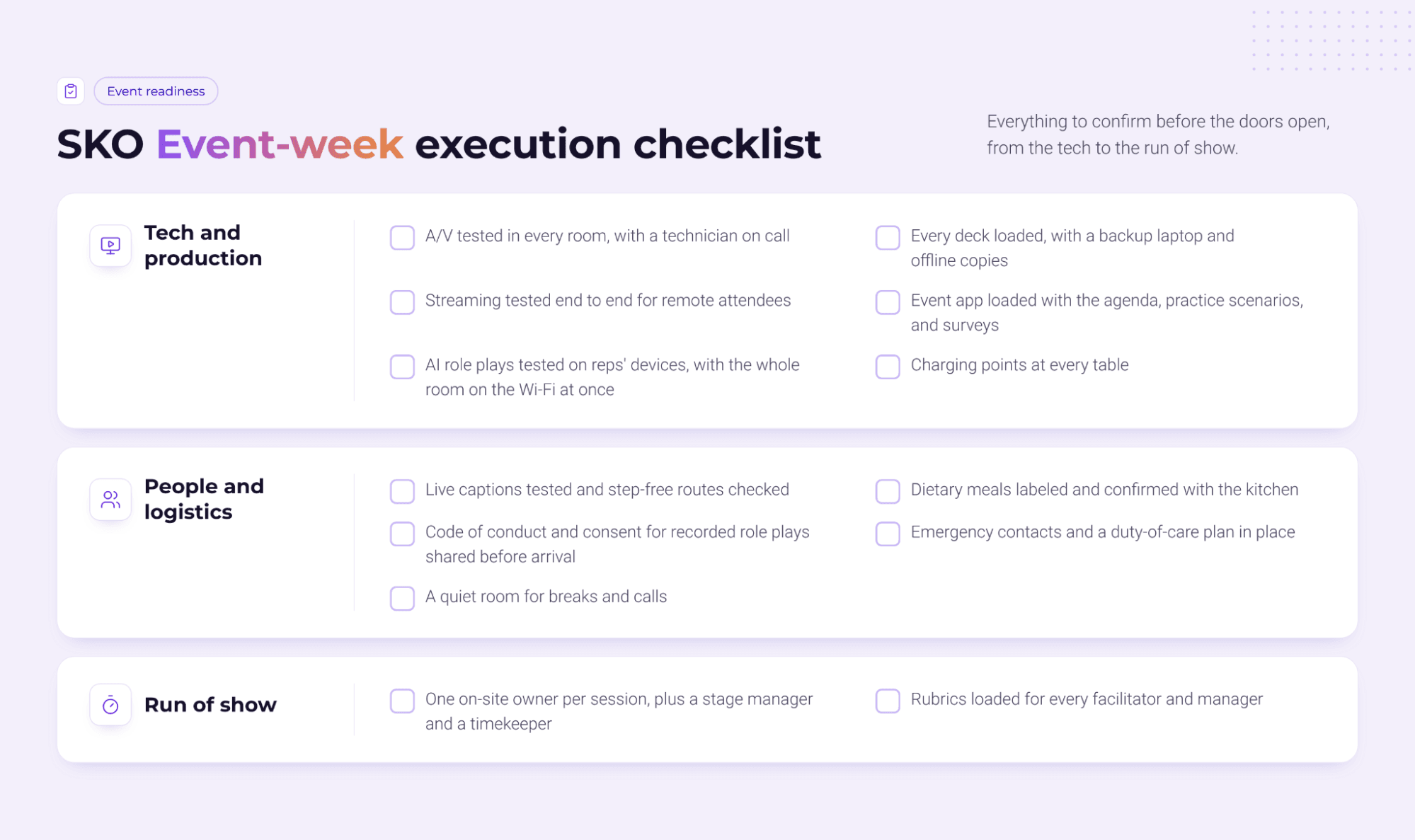
Event-week execution checklist
Anything with a vendor lead time should already be booked, so event week is for checking it all works.
Contingency plan
| What goes wrong | Backup | Who decides |
|---|---|---|
| Speaker no-show or late | A briefed internal stand-in or a practice block | Head of enablement |
| Travel disruption or bad weather | Stream sessions and record everything | Events lead |
| Sessions overrun | Cut from presentations first, never from practice | Stage manager |
| Practice tool outage | Live peer role play with printed rubrics | Enablement |
| Medical or safety incident | Follow the duty-of-care plan; venue security and on-site medical lead | Events lead |
How to measure SKO ROI
Measure a kickoff at four levels.
| Level | What it shows | Example measure |
|---|---|---|
| Reaction | Whether reps found it useful | Daily pulse survey scores |
| Learning | Whether reps can run the plays | AI role play scores and certification rate per play |
| Behavior | Whether reps use the plays in real deals | Share of recorded discovery calls using the new framework, tracked with conversation intelligence |
| Results | Whether it moved the business | Stage conversion and win rate in the target segment |
📌 How to calculate SKO ROI
ROI (%) = (program benefits − program costs) ÷ program costs × 100
Count benefits as gross profit, which is revenue after the cost of delivering it, and include only what you can credibly attribute to the kickoff. Include every cost, selling time too.
For example, $2.1 million in added gross profit against $1.4 million in costs is a 50% return.
At day 90, send finance one page: the outcomes you set, actual spend including selling time, results against baseline, the ROI and its assumptions, and what you'd change next time. Attach the attribution math as an appendix.
💡Learn more: How Top Revenue Enablement Leaders Prove ROI
9 SKO planning mistakes to avoid
Most SKO mistakes come from treating the kickoff as a one-off event, and each has a simple fix.
- Filling the agenda with leadership updates and feature tours. Move one-way content to pre-work and keep keynotes short.
- Letting only the volunteers practice. Use small groups and AI role play so every rep practices.
- Using generic role play scenarios. Build them from your own deals.
- Briefing managers at the same time as reps. Run a manager session first and hand over the 90-day kit.
- Letting every presenter tell a different story. Give one person editorial control over every deck so the narrative and the theme hold together.
- Booking an external keynote you can't brief. Brief and rehearse them, or put the money into practice.
- Treating remote attendees as an audience. Give them their own facilitators and breakouts.
- Planning nothing after the closing session. Design the 90-day plan before the agenda.
- Measuring only satisfaction. Track behavior and results against a baseline.
See how Mindtickle turns your 2027 kickoff into repeatable practice
Frequently Asked Questions
About the Author
Lead Content Marketer
Jayadeep brings over a decade of experience in B2B content and product marketing, with expertise in editorial leadership, messaging strategy, and agency management.
He has built and scaled content operations, led agency partnerships, and collaborated across marketing, product, and demand generation teams to deliver integrated campaigns. His "process-first, execution-next" philosophy has made him a trusted resource at Mindtickle, where he helps shape content strategy, thought leadership programs, and flagship marketing initiatives.
Subscribe to the blog
Get the latest sales enablement tips, guides, and industry best practices delivered to your inbox. Unsubscribe anytime.